









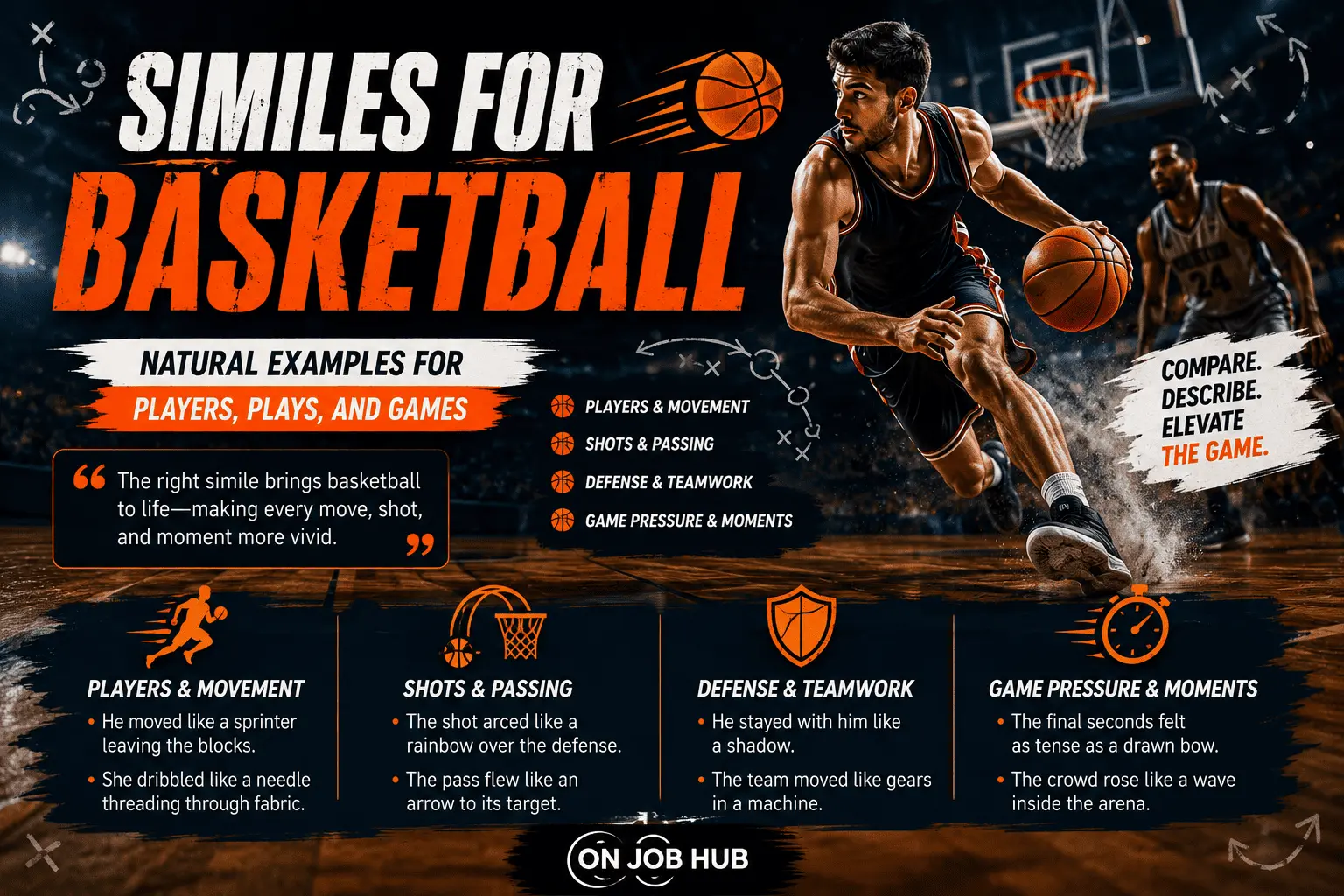
Finding good Similes for basketball is less about making every sentence sound clever and more about choosing a comparison that fits the action. A quick guard, a high-arcing shot, and a tense final possession each need a different kind of image.
This is where Similes for basketball can be more useful than generic comparisons. A player can move like something fast, a shot can travel like something precise, or a defender can close in like something difficult to escape. The comparison should feel connected to what is happening on the court.
What Makes a Basketball Simile Work?
A basketball simile commonly connects two different things with like or as. What matters most is the quality they share. If a player is compared to something fast, the reader should immediately understand that speed is the point. If a pass is compared to something sharp, the image should suggest accuracy, speed, or sudden movement.
The action on the court gives the comparison its meaning. A player might be quick, balanced, powerful, controlled, or difficult to defend. A shot might be smooth, high, fast, or perfectly timed. The ball can be described through its bounce, flight, or spin. Even crowd noise and late-game tension can work when the comparison fits the scene.
This is where Similes for basketball can be more useful than generic comparisons. “He was fast like a cheetah” gives the reader a familiar image, but it says little about how the player’s speed looked during the play. A comparison connected to the movement itself can give the sentence more detail without making it feel forced.
A good simile should also sound natural inside the sentence. If the comparison feels like it was added just to make the writing more colorful, it usually shows.
Similes for Basketball Players and Movement
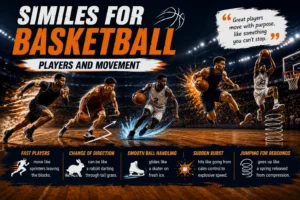
Fast players are often easier to describe through movement than by simply calling them quick. A guard racing into the open court might move like a sprinter leaving the blocks, while a player who changes direction suddenly can seem like a rabbit darting through tall grass.
Dribbling creates different possibilities. A player weaving through defenders might move like a needle threading through fabric, keeping the ball close while slipping through narrow gaps. A guard changing direction sharply can look like a pinball bouncing from one angle to another when the movement is quick and unpredictable.
Some basketball similes work better when they capture control rather than pure speed. A ball handler might glide like a skater on fresh ice, staying smooth while shifting direction. A hesitation move followed by a sudden burst has a different feel because the player goes from calm control to explosive movement.
Jumping and leaping offer another angle. A player rising for a rebound can go up like a spring released from compression. A powerful dunk can feel like a hammer coming down, emphasizing force more than height.
Strength does not always have to mean size. A player holding position in the paint can be like a tree rooted in the ground, difficult to move once planted. Balance can be compared to something steady under pressure, while confidence can come through an image of someone who keeps moving without hesitation.
The strongest player descriptions usually capture more than one quality. A guard who changes direction, protects the ball, and still reaches the rim needs an image that reflects control as well as quickness.
Similes for Basketball Shots, Passing, and Ball Movement
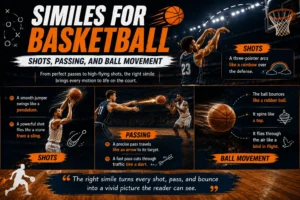
A shot can be described by its motion as well as its result. A smooth jumper might move like a pendulum, while a powerful shot can feel like a stone launched from a sling. For a clean release, the comparison should fit the way the ball leaves the player’s hand.
Long-range shots have a different feel from quick releases. A three-pointer can arc like a rainbow over the defense, while a quick release can disappear like a flash before the defender has time to react. Difficult shots can be described through their angle, timing, or control rather than always falling back on speed.
Passing gives basketball similes another useful area to work with. A precise pass can travel like an arrow toward its target, while a fast pass can cut through traffic like a dart. An assist can also be described through its timing when the ball reaches a teammate exactly when the opening appears.
The ball itself has plenty of movement to describe. It can bounce like a rubber ball, spin like a top, or travel through the air like a bird in flight. The comparison works best when it reflects the movement the reader is supposed to notice.
Similes for Basketball Defense, Teamwork, and Game Pressure
Defense can change the entire feel of a possession. A defender who stays close can be like a shadow, while a tight defensive unit can feel like a wall closing off the lane. A steal or block may call for a sharper image when the action happens suddenly.
Teamwork gives basketball similes a different subject. Five players working together can move like gears in a machine, with each part affecting what happens next. A well-timed rotation or passing sequence can also be compared to something that works smoothly because every movement arrives at the right moment.
Close games create another kind of pressure. During the final seconds, the court can feel as tense as a drawn bow, with every possession carrying extra weight. Crowd noise can rise like a wave, while the energy inside the building can feel electric when the score is close and the clock is running down.
How to Use Similes for Basketball Naturally in Writing
A simile usually works better when it sits inside a complete sentence rather than being dropped into the writing by itself. Connect the comparison to what the player, ball, or team is actually doing so the image has a clear purpose.
When choosing Similes for basketball, think about the player, action, and situation together. A comparison that fits a fast break may sound strange during a slow half-court possession. A tense final possession also needs a different feel from a relaxed practice scene.
Using too many comparisons can crowd the writing. If every sentence describes speed, power, or intensity through another image, the basketball action can get lost. One strong comparison often does more than several weaker ones.
Familiar comparisons can be useful because readers understand them quickly. A less familiar image can work when it adds something specific to the scene. Either way, the comparison should sharpen the description rather than decorate every sentence.
Common Problems With Similes for Basketball
A comparison can be technically correct and still feel wrong for the play. If the image has little connection to the player’s movement, the shot, or the situation, it can make the sentence harder to understand.
Clichéd comparisons can create another problem. If every fast player gets the same familiar comparison, the writing starts to feel predictable. Using slightly different wording to describe the same quality over and over has a similar effect.
Vague basketball similes can also leave the reader guessing. If it is unclear whether the comparison is meant to show speed, balance, force, timing, or something else, the image loses its value.
Tone matters too. A playful comparison might work during a lighthearted description but feel out of place during a serious final possession.
Packing several similes into one sentence rarely makes the description stronger. Once one comparison has given the reader a clear image, another may simply get in the way.
Frequently Asked Questions
What Can Basketball Similes Describe Besides Players?
They can describe shots, passes, dribbling, defensive pressure, teamwork, ball movement, crowd noise, and tense moments during a game. Similes for basketball do not have to focus only on individual players.
How Do You Make a Basketball Simile Sound Natural?
Match the comparison to what is happening in the scene and read it as part of the full sentence. If the image distracts from the action or feels unrelated, it probably does not belong there.
Can Basketball Similes Be Used in Essays and Stories?
Yes. Similes for basketball can work in essays when they support a point, and they can work in stories when they add something useful to the scene.
What Is the Difference Between a Basketball Simile and a Metaphor?
A simile makes a direct comparison, usually with like or as. A metaphor presents one thing as another without making the comparison in the same direct way.
What to Keep in Mind
Useful basketball similes make the situation easier to understand. A clever image is not automatically better if the reader has to stop and figure out why it fits.
Variety does not mean collecting as many comparisons as possible. A fast break, a contested shot, and a tense final possession can need completely different images.
The easiest way to judge a basketball simile is to place it inside the sentence where it will actually appear. If the wording feels natural and helps the reader see the action, the comparison has a clear reason to stay.