










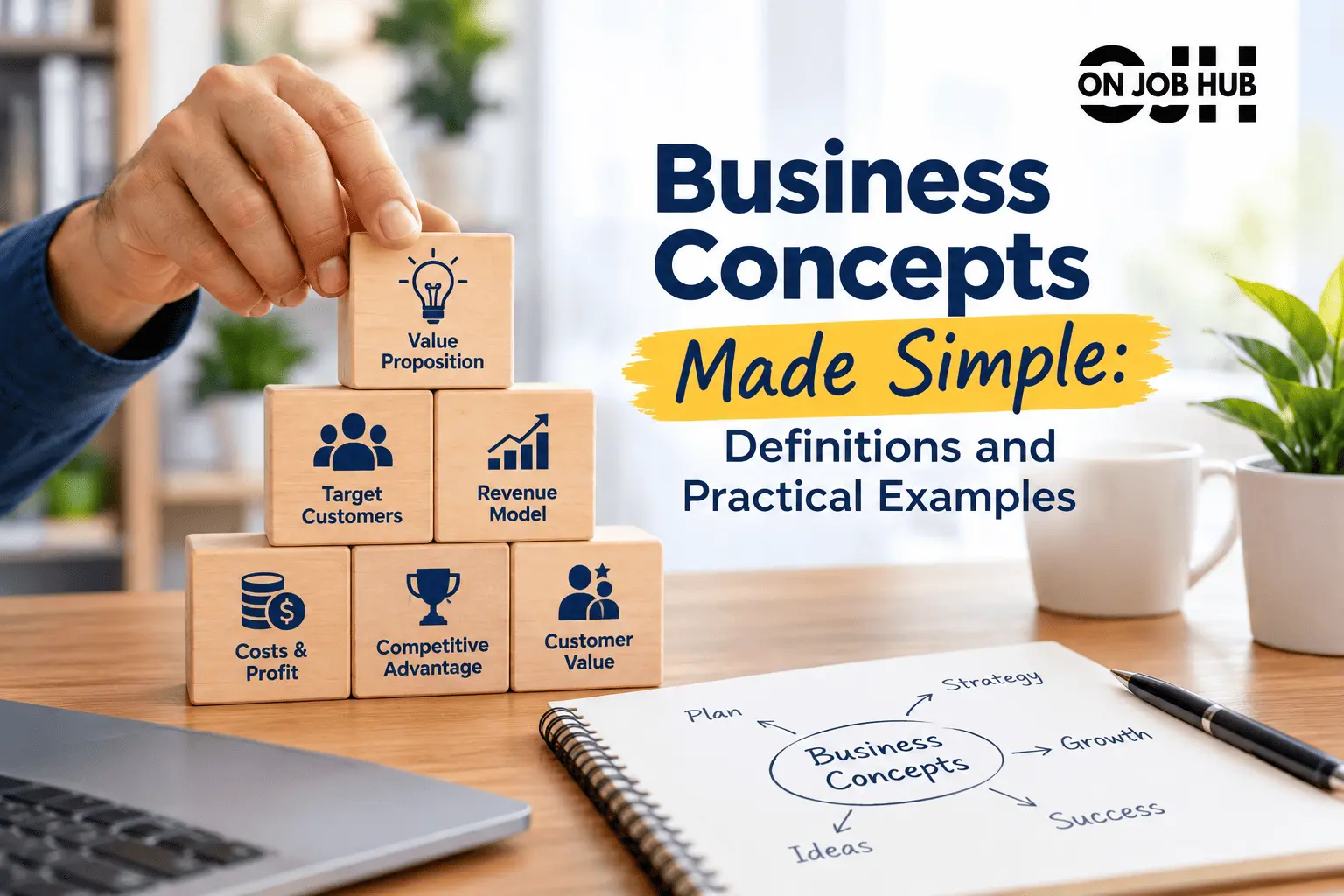
Business concepts are easier to understand when you can connect them to actual business decisions. This guide explains key business concepts in simple terms and shows how they apply to real businesses through practical examples.
You’ll learn how business concepts such as value proposition, target customers, revenue, costs, competitive advantage, and customer value can shape everyday business decisions. The guide also explains related business terms and how these concepts can be applied to your own business.
What Are Business Concepts?
A business concept is the basic idea behind how a business will create value for customers and operate around that value. It gives the business a direction by connecting what it offers, who it serves, and why customers would choose it.
A business idea is usually the starting thought. A business concept gives that idea a clearer direction. Someone might have an idea to sell a product online, for instance, without yet knowing who the product is for or what customer need it addresses. Once those pieces become clearer, the idea starts functioning as a business concept.
A clear concept also helps keep decisions from becoming random. When a business knows what it is trying to offer and who it is trying to serve, choices about products, pricing, resources, and customer experience have something to work against.
That does not mean every successful business begins with a perfectly defined concept. Some concepts become clearer only after the business starts operating and learns what customers actually want.
Why Business Concepts Matter in Real Life
Business concepts matter because they give everyday business decisions some direction. A business owner may need to decide what to sell, which customers to focus on, or where to spend limited resources.
They also help a business look at the problem from the customer’s side. If the concept is built around a real customer need, it becomes easier to judge whether a product or service is actually useful rather than simply something the owner wants to sell.
This becomes especially important for small businesses and startups, where time, money, and staff are often limited. A business does not need to chase every possible customer or opportunity. A clear concept can help it decide what belongs within the business and what does not. For example, small businesses also need to consider cybersecurity when protecting their systems, accounts, and data.
Over time, the concept can also influence growth. If customers consistently see value in what the business provides, the owner has a stronger basis for deciding what to improve, expand, or leave alone.
Core Business Concepts Every Beginner Should Know
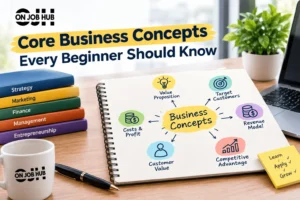
A business concept becomes easier to work with when you break it into a few basic parts. These parts do not operate separately. A change in one can affect the others.
Value Proposition
A value proposition explains why a customer should care about what a business offers. It connects the product or service to a specific benefit or problem.
The important question is not simply, “What do we sell?” It is, “What does the customer get from it?”
Target Customer
A target customer is the particular group of people a business is trying to serve. Defining this group makes the concept more focused because customer needs, buying habits, and expectations can vary widely.
A business that tries to serve everyone can end up making its offer too vague to be useful to anyone in particular.
Revenue Model
The revenue model describes how the business expects to make money from its offering. The basic approach might involve direct sales, subscriptions, service fees, commissions, or another source of revenue.
A good business concept needs more than customer interest. There has to be a for that interest to become revenue.
Cost and Profit
Costs are what the business spends to operate and deliver its offering. Profit is what remains after those costs are paid from the revenue earned.
This distinction matters because strong sales do not automatically mean a business is profitable. If the cost of producing or delivering something is too high, increased sales can still leave little money behind.
Competitive Advantage
Competitive advantage is what gives a business a reason to be chosen over alternatives. It might come from lower costs, better convenience, stronger service, a distinctive product, or another meaningful difference.
The difference needs to matter to the customer. Being different by itself is not enough.
Customer Value
Customer value sits underneath many of these concepts. If the customer does not see enough benefit in the offer, the rest of the business structure becomes harder to sustain.
That is why these concepts are better viewed as rather than a checklist to complete.
Business Concepts Explained with Practical Examples
The same basic concepts can look quite different depending on how a business operates. The underlying questions stay similar: who is being served, what value is offered, how does the business earn revenue, and what does it cost to deliver that value?
Retail Business
A retail business buys or produces products and sells them to customers. Its concept may depend on the type of products it carries, the customers it targets, its pricing, and the shopping experience it provides.
A neighborhood clothing store, for instance, may focus on affordable everyday clothing for local customers. Its concept affects what inventory it carries, how it prices those products, and where it puts its limited resources.
Online Business
An online business delivers its offer through the internet rather than relying mainly on a physical storefront. The concept still needs a defined customer and a clear reason for that customer to buy.
An online business might sell products directly through its website, charge for access to digital content, or provide a service remotely. The technology changes the delivery method, but it does not remove the need for a workable value proposition or revenue model.
Service-Based Business
A service business sells work, expertise, access, or assistance rather than a physical product. Its business concept is often closely tied to the problem it solves and the kind of customer it can serve well.
A home cleaning company, for example, may focus on recurring cleaning for busy households. That focus can shape its service packages, scheduling, pricing, and staffing decisions.
Manufacturing Business
A manufacturing business turns materials or components into products that can be sold to customers or other businesses. Its concept has to account for the product itself as well as production costs, resources, quality, and demand.
A manufacturer cannot treat customer demand as the only concern. If producing the product requires too much time or expense, the concept may need to change even if people want the product.
Common Business Concepts People Often Confuse
Some business terms sit close enough together that they are easy to mix up. The differences become clearer when you look at what each one is actually used for.
Business Concept vs. Business Idea
A business idea is the initial thought about something a business could offer. A business concept gives that thought more structure by connecting the offer with a customer, a need, and a basic way of operating.
The idea starts the thinking. The concept gives that idea a clearer business direction.
Business Concept vs. Business Model
A business concept describes the basic business proposition and the value it aims to provide. A business model goes further into how the business creates, delivers, and captures value.
The two are connected, but they answer different questions. The concept focuses on what the business is built around; the model explains how that setup works economically.
Business Concept vs. Business Plan
A business plan is a more detailed document used to lay out how a business intends to operate. It can cover goals, operations, marketing, finances, resources, and other.
The business concept comes earlier and remains more focused. A plan can be built around a concept, but the two are not interchangeable.
Innovation and Business Concepts
Innovation can shape a business concept, but a concept does not have to be highly innovative to work. A business can build a useful concept around an existing product or service if it serves a customer need in a way that can last.
The useful distinction is between having something new and having something that customers actually value.
How to Apply Business Concepts to Your Own Business

Start with the customer rather than the business structure. Ask what problem people are actually trying to solve and whether that problem is important enough for them to seek a solution. A clear business concept should begin with understanding this customer need.
Once the problem is clear, shape the offer around the value it provides. This is where the business concept becomes more than a general idea. The offer should have a clear reason for existing from the customer’s point of view.
The next question is how the business will turn that value into revenue. The answer does not need to be complicated at first, but it should make sense alongside the way the business delivers its product or service.
Costs and resources need the same reality check. Consider what it takes to produce, deliver, support, and maintain the offer. A concept can sound reasonable until the time, money, people, or materials required to run it are taken seriously.
The concept can then be tested against market feedback. If customers respond differently than expected, that does not automatically mean the whole idea has failed. It may show that part of the concept needs to change.
Common Mistakes When Understanding Business Concepts
One common mistake is treating business concepts like vocabulary terms that only need to be memorized. Knowing a definition is useful, but it does not show whether someone can recognize how that concept affects a real business.
Another mistake is assuming the same concept should work in exactly the same way for every business. A retail company, a service provider, and a manufacturer face different operating conditions, so the relevance of each concept can vary.
Ignoring the customer’s actual need creates another problem. A business can become very focused on what it wants to offer while paying too little attention to whether customers find that offer useful.
Sales and profit are also easy to confuse. Revenue shows money coming into the business, while profit depends on what remains after the relevant costs are paid.
The biggest problem may be treating assumptions as facts before the concept has been tested. A business owner can believe customers will buy, that a price will work, or that costs will stay manageable. The market may give a different answer.
Frequently Asked Questions
What is the difference between a business concept and a business idea?
A business idea is the initial thought about something a business could offer. A business concept gives that thought more structure by connecting it to a customer, a need, and a basic direction.
Does every business need a unique business concept?
No. A business does not have to be completely original to work. An existing type of business can still succeed if it provides useful value and has a workable way to operate.
Can a business concept change over time?
Yes. Customer feedback, changing demand, costs, and business experience can lead to changes in the concept. Adjusting part of the concept does not necessarily mean the original idea has failed.
What is the most important concept for a small business owner?
Customer value is a useful starting point. Knowing what customers need and whether the business provides enough value to address that need can guide many other decisions.
Are business concepts only for startups?
No. Established businesses use the same basic thinking when they review their customers, offerings, costs, and competitive position. These concepts remain relevant as a business changes and grows.
Why are practical examples helpful when learning business concepts?
Examples connect abstract terms to. They make it easier to see how a concept affects decisions instead of treating it as a definition to memorize.
Final Thoughts
Business concepts are more useful when they can be connected to real decisions. Memorizing terms may help with the basics, but understanding what those terms mean in practice gives them more value.
A business concept also does not exist in isolation. What customers need, what the business can realistically provide, and what the market shows can all shape how the concept works.
That is where learning business concepts moves beyond definitions and becomes part of how a business is actually understood and managed.



One thought on “Business Concepts Made Simple: Definitions and Practical Examples”