








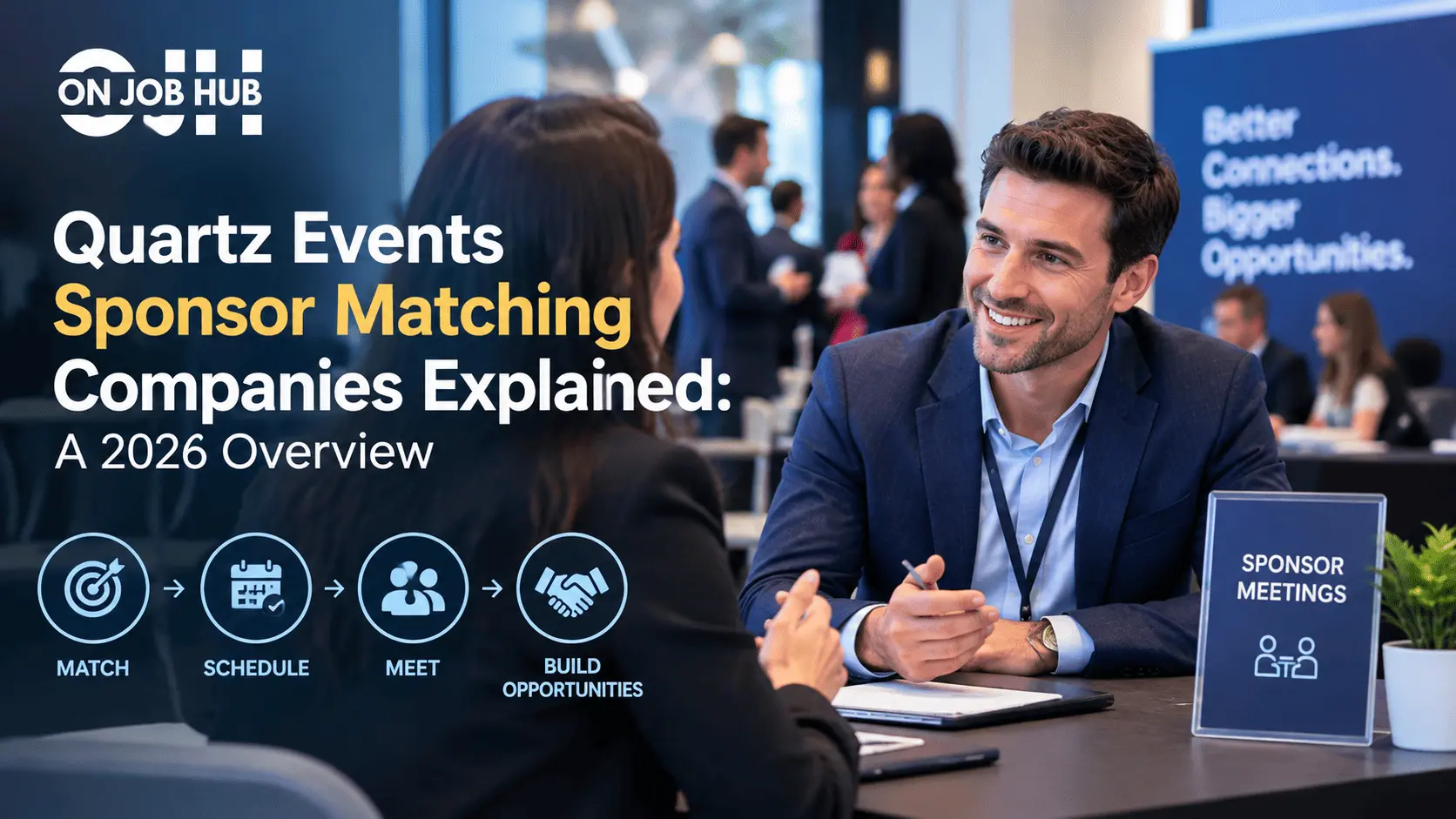
If you’ve been asked to evaluate a sponsorship package and the phrase “guaranteed meetings” keeps showing up, you’ve probably run into Quartz Events Sponsor Matching Companies without realizing there was a whole category behind the pitch. It’s a different way of selling event access. Instead of a booth and a logo on a lanyard, sponsors pay for scheduled, one-on-one conversations with executives who’ve already agreed to show up. That distinction changes the math for marketing and sales teams deciding where to spend a limited events budget. This article breaks down how the model works, what it costs, who it’s built for, and which alternatives exist if it doesn’t fit.
What Are Quartz Events Sponsor Matching Companies?
Quartz Events Sponsor Matching Companies are event platforms — Quartz Network being the best-known example — that sell sponsors guaranteed, pre-scheduled meetings with vetted senior executives instead of general exhibition access. The sponsor describes the buyer it wants to reach; the platform matches that profile against its attendee pool and books the conversations directly.
Quartz Network itself runs role-specific, invite-only leadership summits under brand names like CONNECT HR, CONNECT CMO, CONNECT CFO, and SCOPE Supply Chain. It’s headquartered in Manhattan Beach, California, and now operates as part of Clarion Connect, a division of Clarion North America backed by The Blackstone Group. The company has been running this format for roughly eighteen years, which is longer than most people assume given how “new” the meeting-based sponsorship pitch sounds.
How Does Quartz Events Sponsor Matching Work?
The process starts on the attendee side, not the sponsor side. Executives apply — or get invited — to attend a summit, and during that intake, the organizer collects details about their role, current projects, and the problems they’re actively trying to solve. That data becomes the raw material for matching.
Sponsors then submit their own buyer profile: industry, title level, company size, and the kind of business challenge their product solves. From there, the process generally looks like this:
- The sponsor buys a package tied to a specific number of guaranteed meetings, typically somewhere between 15 and 120 per event.
- The Quartz Events Sponsor Matching Companies model uses attendee intake data to match sponsors against their ideal buyer profile.
- Attendees review a short list of sponsors and confirm which ones they’re actually open to meeting.
- A concierge team builds the meeting schedule and shares qualification notes with the sponsor ahead of time.
Picture a mid-size cybersecurity vendor that would normally send two reps to a trade show floor and hope the right IT director walks by. At a curated Quartz-style event, that same vendor might instead sit down with 25 pre-qualified security or compliance leaders who’ve already indicated they’re evaluating solutions in that category. The rep walks in knowing the attendee’s title, company, and stated priority before the conversation even starts.
Why Sponsor Matching Has Become More Important in 2026
Sponsorship budgets are tighter than they were a few years ago, and marketing leaders are under more pressure to justify event spend with something more concrete than “we had good booth traffic.” That shift is a big part of why this model has gained ground.
For companies researching Quartz Events Sponsor Matching Companies, the appeal is that event spending can be connected more directly to actual conversations with potential buyers.
Corporate inboxes are also flooded with sponsorship requests. Most get ignored because there’s no clear tie between the event’s audience and the sponsor’s actual buyer. A matching-based approach cuts through that by starting with relevance instead of volume — the event organizer isn’t selling generic exposure, it’s selling access to specific, already-interested people.
It matters most for B2B companies with longer sales cycles, higher contract values, and buyers who are genuinely hard to reach through cold outbound. It matters a lot less for consumer brands or low-cost transactional products, where broad visibility usually beats a small number of curated conversations.
Key Features of the Model
The main features that make Quartz Events Sponsor Matching Companies different from traditional event sponsorship include:
- Guaranteed meeting volume — sponsors know in advance roughly how many qualified conversations they’ll get, not just how many badges scanned at a booth.
- Pre-meeting intelligence — sponsors typically receive background on each matched attendee, including role and current priorities, before the meeting happens.
- Attendee opt-in — executives choose which sponsors they’re willing to meet, so conversations start with some baseline interest rather than a cold approach.
- Concierge scheduling — the platform’s own team manages logistics, so sponsor reps aren’t chasing calendar invites during the event.
- Bundled thought leadership — many packages also include a speaking slot, panel seat, or workshop session layered on top of the meetings.
Benefits of Using Sponsor Matching Companies
Sponsor matching can make event participation more valuable when the goal is to build qualified business relationships rather than simply increase visibility. Understanding basic business concepts can also help sponsors evaluate how these meetings fit into their broader sales and growth strategy.
The most obvious benefit is time. Sales and marketing teams that would otherwise spend weeks researching prospects and requesting intro calls get a compressed version of that same funnel over the course of a two- or three-day event.
There’s also a real difference in conversation quality. A rep who walks into a meeting already knowing the attendee’s job title, department, and current initiative can skip the throat-clearing and get to a useful discussion faster. That tends to produce better pipeline than a booth conversation with someone who’s mostly there for the free coffee.
Predictability is the third piece worth mentioning. Traditional sponsorship is a bit of a gamble — you buy a package and hope the right people show up. The Quartz Events Sponsor Matching Companies approach gives finance and marketing teams a number they can actually plan around when they’re building next year’s events budget.
None of this guarantees closed deals, though. A qualified meeting still has to be followed up on well, and sponsors who treat the meeting itself as the finish line tend to be disappointed.
How to Evaluate and Book a Sponsorship Package
When evaluating Quartz Events Sponsor Matching Companies, use the following steps:
- Define your buyer profile precisely. Vague targeting (“mid-market companies”) produces weak matches. Specify title level, function, industry vertical, and the trigger event that signals someone’s ready to talk.
- Ask what “qualified” actually means. Get a clear definition of how attendees are vetted before you agree to a meeting count — title-only qualification is a lot weaker than qualification based on stated buying intent.
- Request references from similar sponsors. Ask for a company in your category that ran a package last year and find out what their actual meeting-to-pipeline conversion looked like.
- Confirm the cancellation and no-show policy. Executive attendees do drop out, and it matters whether the platform backfills those meetings or simply reduces your count.
- Plan your follow-up sequence before the event. A guaranteed meeting is only valuable if someone owns the follow-up email, the demo booking, and the CRM entry the same week.
Before you commit, ask for the guaranteed meeting count, attendee qualification criteria, cancellation terms, and how replacements are handled. If you’re comparing the value of different sponsorship models, understanding Quartz Events Sponsor Matching Companies can help you evaluate whether the investment makes sense.
Quartz Events Sponsor Matching vs. Traditional Sponsorship
| Factor | Sponsor Matching (Quartz-style) | Traditional Exhibition Sponsorship |
|---|---|---|
| Access | Guaranteed, pre-scheduled meetings | Booth traffic, self-directed networking |
| Buyer qualification | Vetted in advance by the organizer | Largely unknown until the conversation happens |
| Cost structure | Priced per meeting volume tier | Priced per booth size or sponsorship level |
| Best fit | Complex B2B sales, high contract value | Broad brand awareness, lower-cost products |
| Scheduling effort | Handled by the platform’s team | Handled by the sponsor’s own staff |
Companies comparing Quartz Events Sponsor Matching Companies with traditional sponsorship should consider what they actually need from an event.
Traditional exhibition sponsorship still makes sense for companies that want broad visibility across an entire industry, not just a narrow set of accounts. It’s usually cheaper per dollar of reach, even if the leads are less qualified individually. Sponsor matching wins when the buyer pool is small, specific, and hard to reach any other way — which is exactly the kind of audience Quartz’s CONNECT and VISIONS series are built around.
Common Mistakes to Avoid
When working with Quartz Events Sponsor Matching Companies, avoid these common mistakes:
- Treating meeting count as the only metric. Twenty mediocre matches are worth less than eight sharply relevant ones. Push for quality data on how targeting is actually done.
- Skipping internal alignment before the event. If sales doesn’t know which reps are covering which meetings, qualified conversations get wasted on the wrong person.
- Not budgeting for follow-up. The sponsorship fee covers the meeting, not the three-touch nurture sequence that turns it into a deal — plan for that separately.
- Assuming every attendee is a decision-maker. Some matched attendees are influencers, not final approvers. Ask the platform to clarify seniority and purchasing authority up front.
- Choosing the wrong event series. A sponsor selling supply chain software gets little value from a CMO-focused summit, even if the pricing looks attractive.
Tips for Getting Better Results
If you’re considering Quartz Events Sponsor Matching Companies, send your most experienced rep to the meetings, not the newest hire. Attendees in this format expect a substantive conversation, not a scripted pitch, and an experienced rep can adjust on the fly when the discussion veers off the deck.
It’s also worth asking the sponsorship team, before you sign, exactly how many of last year’s attendees in your target function actually attended versus registered — no-show rates vary more than people expect. Finally, don’t skip the thought-leadership add-on if it’s offered. A short workshop slot in front of the full room tends to generate warm inbound conversations beyond just your scheduled meetings.
Frequently Asked Questions
What is Quartz Events sponsor matching?
Quartz Events Sponsor Matching Companies represent a sponsorship model where companies pay for a guaranteed number of pre-scheduled, one-on-one meetings with vetted senior executives, rather than for general booth space or logo visibility at an event.
Is Quartz Events sponsor matching worth it in 2026?
It depends on the sponsor’s sales motion. For B2B companies selling complex, higher-value solutions to a narrow set of senior buyers, the model tends to justify its cost through better-qualified conversations. For low-cost or consumer-facing products, traditional broad-reach sponsorship is usually a better use of budget.
Who should use quartz events sponsor matching companies?
Software and services companies targeting VP-level or C-suite buyers in functions like HR, finance, marketing, supply chain, or IT tend to get the most value. Businesses without a clearly defined buyer profile or a sales team ready to follow up quickly are less likely to see a strong return from Quartz Events Sponsor Matching Companies.
How does the matching process actually work?
Attendee intake data — role, priorities, current challenges — is collected before the event and cross-referenced against each sponsor’s stated buyer profile. Attendees then opt in to meetings they’re interested in, and the platform’s team builds and manages the final schedule.
What are the main benefits of sponsor matching over traditional sponsorship?
Guaranteed meeting volume, pre-meeting attendee intelligence, and reduced time spent chasing scheduling logistics are the biggest advantages, along with generally higher-quality conversations than unstructured booth traffic.
Are there companies similar to Quartz Network?
Yes. Argyle Executive Forum runs a comparable invite-only executive summit model. CXOsync operates in the same C-suite event-matching space at a smaller scale, and Evanta, part of Gartner, runs peer-community executive events with its own sponsor matching option. These alternatives are worth reviewing alongside Quartz Events Sponsor Matching Companies if you want to compare audience types and sponsorship structures.
How much do Quartz-style sponsorship packages typically cost?
Pricing isn’t publicly listed and varies by meeting volume, event series, and audience function — it’s sold directly through the platform’s sponsorship account executives, so getting an accurate quote means requesting one for your specific target audience. This is important to consider when comparing Quartz Events Sponsor Matching Companies against standard exhibition packages.
Can smaller companies participate in this kind of sponsorship?
Smaller vendors can participate, but the model tends to suit companies with an established sales process and a reasonably high average deal size, since the cost per meeting is higher than a standard exhibition booth fee.
Final Thoughts
The core idea behind Quartz Events Sponsor Matching Companies isn’t complicated — it’s paying for relevance instead of paying for exposure. That trade-off works well for B2B vendors chasing a narrow, senior buyer pool, and works less well for anyone selling something broad or low-cost.
Before signing a package, get specific about how qualification actually happens, line up your follow-up plan, and treat the meeting as the start of a sales process rather than the result of one.