










Similes About Dogs can make a character, action, or feeling easier to picture without making the writing feel overly decorated. The useful ones are usually tied to something specific: loyalty, restless energy, fear, protectiveness, or plain old curiosity.
The right comparison depends on the scene. A playful dog image may work well in a child’s story but feel out of place in a serious personal essay. These examples are meant to give you choices you can actually use, then adjust to fit the voice of your piece.
What Makes a Dog Simile Effective?
A simile compares one thing with another, usually using “like” or “as.” The comparison should make the character’s feeling easier to picture.
A metaphor makes the comparison more directly, without using “like” or “as.” In this example, saying someone is as loyal as a dog is a simile, while saying someone is a loyal dog makes the comparison directly.
A dog works well in a simile because readers already associate dogs with recognizable traits such as loyalty, excitement, alertness, affection, and protectiveness. Still, those associations are not universal. A comparison feels stronger when the dog’s behavior matches the character.
Good Similes About Dogs tend to be specific enough to create a picture, but simple enough that the reader does not have to stop and decode them. If the comparison calls more attention to itself than the character or scene, it probably is not helping much.
30 Similes About Dogs with Meanings and Examples
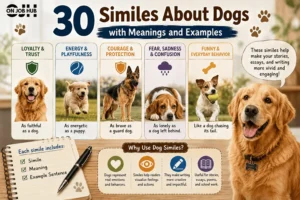
These Similes About Dogs are grouped by the quality or behavior they describe, rather than just the sound of the phrase.
Similes That Show Loyalty and Trust
- As faithful as a dog
Meaning: Completely loyal and dependable.
Example: Marcus stayed beside his friend, as faithful as a dog. - Like a dog guarding its owner
Meaning: Protective and deeply devoted.
Example: She watched over her little brother like a dog guarding its owner. - As loyal as a dog to its family
Meaning: Strongly committed to the people it cares about.
Example: He was as loyal as a dog to his old teammates. - Like a dog waiting by the door
Meaning: Patiently waiting for someone to return.
Example: She waited for her father like a dog waiting by the door. - As trusting as a friendly dog
Meaning: Open, trusting, and willing to accept others.
Example: The child was as trusting as a friendly dog. - Like a dog following its favorite person
Meaning: Staying close to someone out of affection or loyalty.
Example: The younger boy followed his sister like a dog following its favorite person.
Similes That Show Energy and Playfulness
- As energetic as a puppy
Meaning: Full of energy and eager to move.
Example: The children were as energetic as puppies after lunch. - Like a puppy chasing a ball
Meaning: Moving with excitement and enthusiasm.
Example: He ran across the yard like a puppy chasing a ball. - As playful as a young dog
Meaning: Cheerful, active, and ready for fun.
Example: She was as playful as a young dog in the fresh snow. - Like a dog racing through an open field
Meaning: Moving freely and with excitement.
Example: He sprinted down the trail like a dog racing through an open field. - As bouncy as a puppy
Meaning: Lively and constantly moving with excitement.
Example: The little boy was as bouncy as a puppy all morning. - Like a puppy discovering a new toy
Meaning: Showing intense curiosity and excitement.
Example: She examined the old camera like a puppy discovering a new toy.
Similes That Show Courage and Protection
- As brave as a guard dog
Meaning: Fearless when protecting others.
Example: The firefighter stood as brave as a guard dog at the entrance. - Like a dog standing between its owner and danger
Meaning: Willing to face danger to protect someone.
Example: He stepped forward like a dog standing between its owner and danger. - As watchful as a guard dog
Meaning: Alert and ready to notice trouble.
Example: The night guard was as watchful as a guard dog. - Like a dog defending its home
Meaning: Firmly protecting a place or person.
Example: She argued for her family like a dog defending its home. - As fearless as a dog facing a stranger
Meaning: Showing courage when confronted by something unfamiliar or threatening.
Example: The young captain was as fearless as a dog facing a stranger. - Like a loyal dog standing at the gate
Meaning: Remaining steady and protective despite pressure.
Example: He stayed at his post like a loyal dog standing at the gate.
Similes That Show Fear, Sadness, or Confusion
- As nervous as a frightened dog
Meaning: Extremely uneasy or anxious.
Example: She was as nervous as a frightened dog before the interview. - Like a lost dog in a strange town
Meaning: Confused and unsure of where to go.
Example: Without his map, he wandered around like a lost dog in a strange town. - As lonely as a dog left behind
Meaning: Feeling deeply alone or abandoned.
Example: He sat on the porch, as lonely as a dog left behind. - Like a dog hiding from a storm
Meaning: Trying to escape something frightening.
Example: The child curled beneath the blanket like a dog hiding from a storm. - As confused as a puppy in a new house
Meaning: Unsure about what is happening or where to go.
Example: I felt as confused as a puppy in a new house on my first day there. - Like a sad dog waiting in the rain
Meaning: Quietly showing sadness and disappointment.
Example: He stood outside the empty house like a sad dog waiting in the rain.
Similes That Show Funny or Everyday Behavior
- Like a dog chasing its tail
Meaning: Going in circles without getting anywhere.
Example: They kept arguing about the same point like a dog chasing its tail. - As curious as a dog sniffing a new box
Meaning: Very interested in something unfamiliar.
Example: The children were as curious as dogs sniffing a new box. - Like a dog begging for a treat
Meaning: Asking eagerly for something wanted.
Example: He looked at his mother like a dog begging for a treat. - As stubborn as a dog refusing to leave the park
Meaning: Unwilling to change one’s mind or stop doing something.
Example: The child was as stubborn as a dog refusing to leave the park. - Like a dog hearing a strange noise
Meaning: Suddenly alert and focused on something unusual.
Example: She turned toward the hallway like a dog hearing a strange noise. - As messy as a dog after playing in mud
Meaning: Covered in dirt or leaving things untidy.
Example: The kids came home as messy as dogs after playing in mud.
Choosing the Right Simile for Your Writing

Start with the scene before choosing the simile, not the simile itself. If the character is frightened, a playful comparison can feel wrong even if the wording sounds clever. If the scene is light, a heavy comparison may slow it down.
Match the dog’s quality to the quality you want the reader to notice. Loyalty, nervousness, stubbornness, energy, and curiosity each point in different directions.
Think about who will read the piece, too. A school essay may need a clearer comparison than a comic story or a poem. Natural wording usually works better than a phrase that sounds impressive but doesn’t fit the voice of the writing.
Using Dog Similes in Different Types of Writing
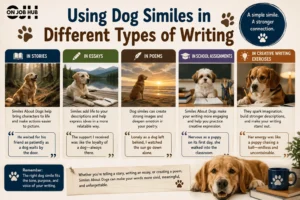
In stories, Similes About Dogs can help reveal a character’s behavior or make an action easier to picture. They work best when the comparison adds something to the scene rather than simply decorating it.
Essays can use them when a description needs a little more life, especially in personal or descriptive writing. For formal essays, the comparison still needs to fit the subject and tone.
Poems have more room for unusual imagery, so a dog simile can carry emotion as well as a visual detail. In creative writing exercises and school assignments, Similes About Dogs can also give students a simple way to practice description.
How to Create Your Own Dog Similes
Start with one behavior rather than trying to describe the whole dog. A dog waiting, digging, guarding, sniffing, or racing gives you something specific to work with.
Then identify the quality behind that behavior. Is it patient, restless, protective, curious, or determined?
Find an object, movement, or feeling that shares that quality. The comparison does not need to be elaborate. It just needs to make sense beside the original behavior.
When creating Similes About Dogs of your own, put the comparison into a complete sentence and read it back. If the meaning is clear without a long explanation, the comparison is clear; if it feels forced, the comparison itself may be the problem.
Common Mistakes to Avoid
A simile can weaken a sentence when the comparison is doing more work than the idea itself. A few problems show up often.
- Confusing a simile with a metaphor: A simile makes the comparison explicit, while a metaphor treats one thing as another. Mixing the two can make a sentence unclear.
- Using too many similes: Filling every sentence with comparisons can make the writing feel crowded. One useful comparison can be enough.
- Ignoring the context: A comparison should fit the character, scene, and mood. A cheerful image can feel out of place in a tense scene.
- Relying only on familiar clichés: Common phrases are easy to recognize, but they may not add much to a piece of writing.
- Explaining the comparison too much: If the reader has to be told several times what a simile means, the image may lose its effect.
Frequently Asked Questions
What is the most common dog simile?
As faithful as a dog is a familiar dog simile because dogs are commonly associated with loyalty and devotion. Similes About Dogs often use this kind of comparison because the connection is immediately clear.
Can dog similes be used in formal essays?
Yes, when the comparison fits the subject and tone. In a formal essay, a clear and relevant simile is usually more useful than one added just to sound creative. Similes About Dogs can work when they support the point rather than distract from it.
What is the difference between a dog simile and a dog metaphor?
A dog simile makes a comparison using words such as “like” or “as.” A dog metaphor makes the comparison more directly, without those comparison words.
How can students remember dog similes easily?
Grouping them by qualities such as loyalty, energy, courage, sadness, or humor can make them easier to recall. This approach also makes Similes About Dogs easier to select for different writing situations.
Can I create my own original dog similes?
Yes. Start with a specific dog behavior, identify the quality behind it, and find another thing that shares that quality. With practice, you can create Similes About Dogs that feel natural and original.
Are puppy similes different from dog similes?
They can be. Puppy imagery often suggests youth, energy, curiosity, or playfulness, while dog imagery can describe a wider range of qualities.
Can you give me 10 examples of similes?
Yes. The main list above includes 30 dog similes, so you can choose any 10 that fit the tone and purpose of your writing. These Similes About Dogs can be adapted to stories, essays, poems, and school assignments.
Final Thoughts
A useful dog simile should fit what is happening in the scene and what the writer wants the reader to notice. The meaning matters as much as the wording.
Once you pay attention to context and behavior, creating your own comparisons becomes much easier. A simple observation can give you a stronger image than a phrase chosen only because it sounds clever.
The best similes do not need much explanation. They fit the sentence, make the image clearer, and let the writing keep moving. For writers looking for practical Similes About Dogs, the strongest choices are usually the ones that feel natural within the scene.